
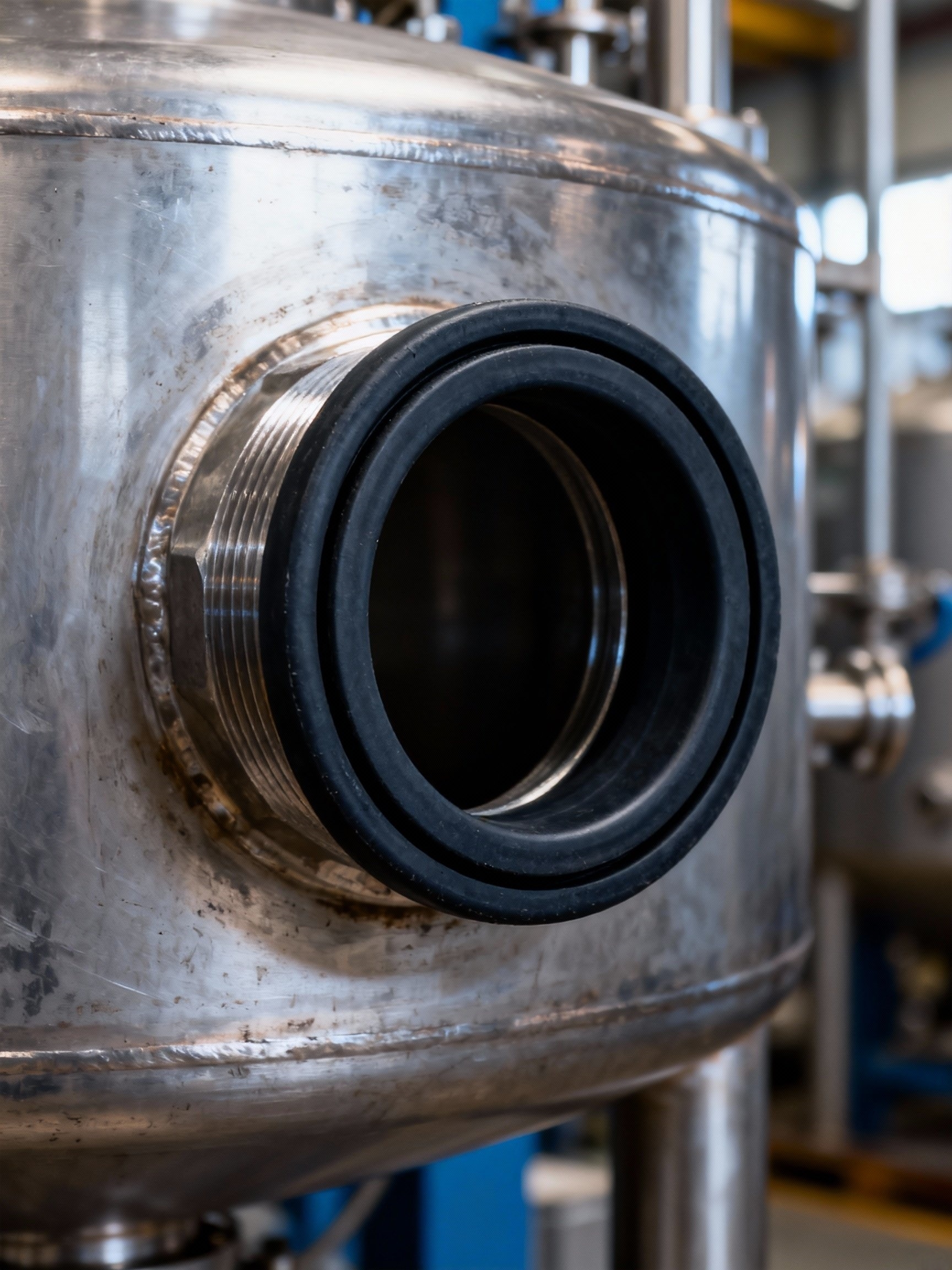
Service Life of FKM Gaskets in Petrochemical Reactors.
The service life of fluoroelastomer (FKM) gaskets in petrochemical reactors is primarily influenced by four key factors: medium characteristics, operating conditions, gasket design and installation, and the inherent properties of the material itself. These factors interact to directly determine the sealing reliability and durability of the gasket. I. Medium Characteristics 1. Medium Type and Corrosivity Acids and alkalis (e.g., concentrated sulphuric acid, concentrated nitric acid), hydrocarbon solvents, and halogen compounds within reactors directly erode FKM’s molecular structure. While conventional FKM exhibits excellent resistance to acids, alkalis, and hydrocarbons, it degrades readily in strongly oxidising media (e.g., concentrated nitric acid, chlorinated hydrocarbons), leading to gasket hardening and brittle fracture. Fluorinated solvents (e.g., perfluorooctane) cause FKM swelling and strength reduction. Example: For reactors handling hydrochloric acid/sodium hydroxide, FKM gaskets may last 1-2 years; when exposed to chlorinated hydrocarbons, standard FKM fails within 3 months, necessitating replacement with FFKM (perfluoroelastomer) gaskets. 2. Medium Temperature and Pressure When temperatures exceed FKM’s tolerance limits (standard FKM withstands 200°C continuously and 250°C intermittently), rubber molecular chains accelerate ageing, leading to thermal cracking and reduced cross-linking density. This manifests as gasket loss of elasticity and seal surface leakage. Sudden temperature changes (e.g., reactor heating/cooling rates >5°C/min) cause uneven thermal expansion and contraction, generating internal stresses that result in cracking.
Pressure fluctuations (particularly in ultra-high-pressure conditions exceeding 30MPa) exacerbate permanent compression deformation of the gasket. When deformation exceeds 25%, the gasket cannot recover its original shape, resulting in seal failure.
II. Operational Factors 1. Reactor Operating Frequency Frequent start-up and shutdown cycles (e.g., 1-2 times daily) subject gaskets to repeated “compression-relaxation” cycles, accelerating fatigue ageing: each cycle causes surface wear through friction between the gasket sealing face and reactor flange, leading to misalignment and leakage after multiple cycles.
Continuously operated reactors (inspected only monthly) experience minimal cyclic stress on gaskets, extending their service life by 30%-50% compared to frequent start-stop conditions. 2. Impurities and Particles in the Medium Solid particles within the reactor (e.g., catalyst residues, raw material impurities) can embed into the gasket sealing surface, compromising seal integrity. Simultaneously, these particles cause surface scratches during medium flow, creating leakage pathways. Metal ions in impurities (e.g., Fe³⁺, Cu²⁺) further catalyse the oxidative degradation of FKM (Fluoroelastomer). Metal ions within impurities (e.g., Fe³⁺, Cu²⁺) may catalyse oxidative degradation of FKM. III. Gasket Design and Installation Factors 1. Gasket Structure and Dimensions Excessively thin gaskets (<3mm) risk crushing under flange clamping force, while overly thick gaskets (>8mm) exhibit reduced compression recovery; Pure FKM gaskets without reinforcement layers are prone to extrusion deformation under high pressure. Composite gaskets with metallic reinforcement (e.g., stainless steel mesh) exhibit superior extrusion resistance, doubling service life. Sealing face width compatibility: When the gasket sealing face width is smaller than the flange sealing face width, localised stress concentration occurs, increasing susceptibility to pitting damage.
2. Installation Process Uneven flange clamping force (e.g., bolt torque deviation >10%) causes localised over-compression of the gasket, resulting in permanent deformation. Insufficient clamping force leads to poor sealing surface contact, facilitating media permeation. Contamination of the gasket surface with oil or dust during installation, or scratches on the flange sealing surface (depth >0.2mm), compromises the sealing interface and shortens service life. Misalignment or wrinkling of the gasket during installation may also cause localised stress cracking. ④ Material Properties 1. FKM Vulcanisation System and Compounding ▪ FKM vulcanised with bisphenol systems exhibits excellent resistance to fuel oils and engine oils, but weaker resistance to strong acids and high-temperature ageing. ▪ FKM vulcanised with peroxide systems offers superior chemical corrosion resistance and better long-term stability, making it more suitable for petrochemical reactors.
The type of filler (e.g., carbon black, silica) in the formulation: FKM gaskets filled with high-abrasion-resistant carbon black exhibit enhanced wear resistance but slightly reduced elasticity; halogen-free fillers are more suitable for high-purity reactors but incur higher costs.
2. Material ageing resistance FKM gaskets without added antioxidants or ozone stabilisers are prone to thermo-oxidative ageing in high-temperature, oxygen-rich environments, manifesting as increased hardness and reduced elongation. FKM gaskets incorporating antioxidants RD or MB can extend thermo-oxidative ageing life by 20%-30%.
Grade variations: Viton® GLT (66% fluorine content) offers superior temperature and chemical resistance compared to standard Viton® A (60% fluorine content), resulting in extended service life within reactors. Key measures to prolong service life: 1. Medium-specific selection: Employ peroxide-cured FKM or FFKM gaskets for highly corrosive/high-temperature conditions; use bisphenol-cured FKM for standard applications. 2. Optimise installation: Tighten bolts uniformly using a torque wrench (tolerance ≤5%), ensure flange sealing surfaces are smooth (Ra ≤0.8μm), and clean gasket and flange surfaces prior to installation. 3. Regular maintenance: Inspect gasket compression set every 3-6 months (acceptable ≤15%). Replace immediately if surface cracks or swelling are detected. For reactors with frequent start-up/shutdown cycles, select FKM gaskets with elastic recovery rate >80%.