The Production Process of Custom Seals
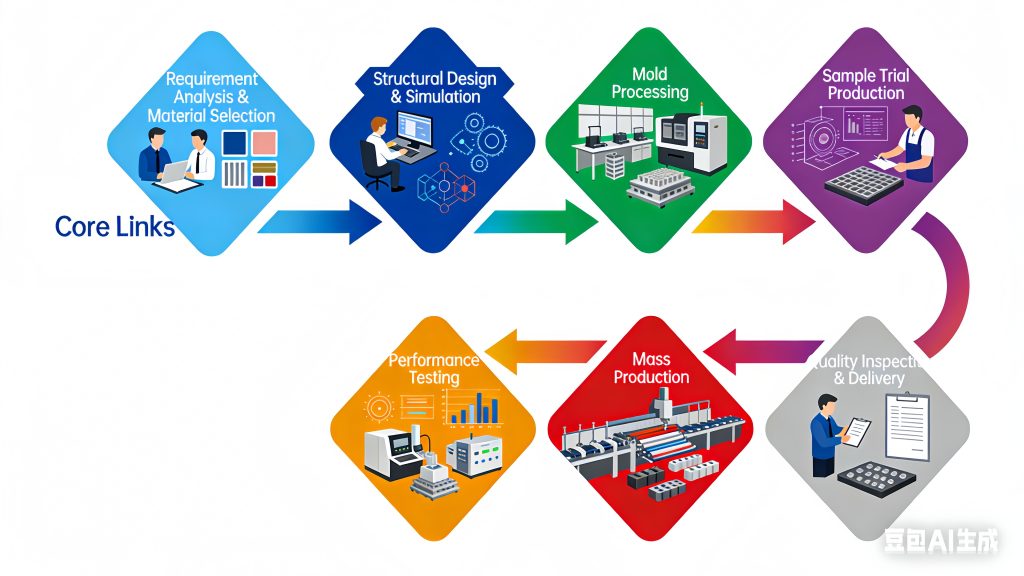
The production of custom seals is a systematic process driven by customer operating conditions, integrating design, validation, manufacturing, and testing. Its core objective is to ensure precise compatibility between the product and its application scenario, encompassing seven key stages. **Requirement Analysis and Material Selection** marks the starting point of production. The technical team must comprehensively gather customer operating parameters—including sealing medium, temperature, pressure, motion type, and installation space constraints—to determine the seal material based on requirements. For instance, highly corrosive media require fluorocarbon rubber (FKM) or PTFE composite materials, while high-temperature applications favor perfluoroelastomer (FFKM). Special conditions necessitate additional compatibility testing, such as material immersion and temperature resistance, to ensure physical and chemical properties meet operational requirements.
**Structural Design and Simulation Optimization** is the core step in performance assurance. Engineers design structures like O-rings, V-rings, and custom seals based on installation dimensions and seal type, specifying details such as lip angle and cross-sectional dimensions. Concurrently, Finite Element Analysis (FEA) simulates stress distribution and contact pressure during operation to optimize designs for extrusion resistance and installation guidance, preventing stress concentration or insufficient sealing surface pressure.
**High-Precision Mold Machining** serves as the foundational production platform. Based on final design drawings, molds are manufactured using CNC machining, EDM (Electrical Discharge Machining), and other processes. Precise calculation of material shrinkage rates (e.g., rubber vulcanization shrinkage of 1%-3%) is essential to ensure cavity dimensional tolerances are controlled within ±0.01mm. After mold completion, precision is verified using a coordinate measuring machine (CMM). Simultaneously, rational venting channels and gating systems are designed to prevent defects like bubbles or short shots during vulcanization or injection molding.
**Sample Prototyping and Process Tuning** serves as the critical phase for feasibility validation. Small-batch trials are conducted according to established process parameters. For rubber seals, vulcanization temperature, pressure, and duration must be strictly controlled. For plastic seals, injection temperature and cooling rate are key parameters. Post-prototyping, samples undergo dimensional inspection and visual screening. Should issues like flash or deformation arise, process parameters are promptly adjusted to ensure samples meet design specifications.
**Performance Testing and Validation** serves as the core basis for product qualification. Testing encompasses two categories: fundamental performance and operational simulation. Fundamental performance tests include hardness, tensile strength, compression set, and other metric evaluations. Operational simulation tests replicate actual working pressures and rotational speeds on specialized test rigs to assess seal leakage rates, wear resistance, and service life. Testing data failing to meet standards necessitates redesign and process optimization.
**Mass Production and Quality Control** ensures scalable delivery. Automated production lines standardize process parameters, while critical stages implement Statistical Process Control (SPC) for real-time dimensional monitoring. Products undergo batch-by-batch inspection per AQL sampling standards, verifying dimensions, appearance, and performance to prevent nonconforming items from advancing.
**Packaging and Delivery** conclude the process. Vacuum or rust-proof packaging is selected based on seal material to prevent scratches and aging during transit. Deliveries include product certificates of conformity, material specifications, performance test reports, and installation manuals, complemented by after-sales technical support to form a complete service loop.